
- Qintar
- Free sheets
- Pricing a Piece in Your Gold Shop
Pricing a Piece in Your Gold Shop
What should a piece cost on your counter? This sheet builds the price of any gold piece from its parts: the gold at the price you buy at, the wastage lost in making, the making charge you collect, 14% VAT on the making charge only, and your margin. It rounds the result to the step you choose and writes a price tag ready to print. Every rate that belongs to your shop is an input you type; the figures in the file are marked examples, not recommendations.
Opens in Excel, or upload the file to Google Drive and open it with Google Sheets. You type in the yellow cells; everything else is worked out for you.
How to use it
- Type today's gold cost: Enter the price per gram at which you buy 24K, 21K and 18K today, for example from Qintar's gold price page.
- Set VAT and rounding: VAT is 14% on the making charge, in a cell you can change. Choose the rounding step: 1, 5, 10 or 50 EGP.
- Add each piece: Type the description, karat and weight, then your wastage percent, making charge per gram and margin percent.
- Read the breakdown: The row shows the gold cost, wastage cost, making charge revenue, VAT, the price before and after VAT, the rounded selling price and your margin in EGP.
- Print the tags: Copy the price tag column or print the sheet. Delete the example rows first.
Example a 10 g 21K chain and a 4 g 18K ring
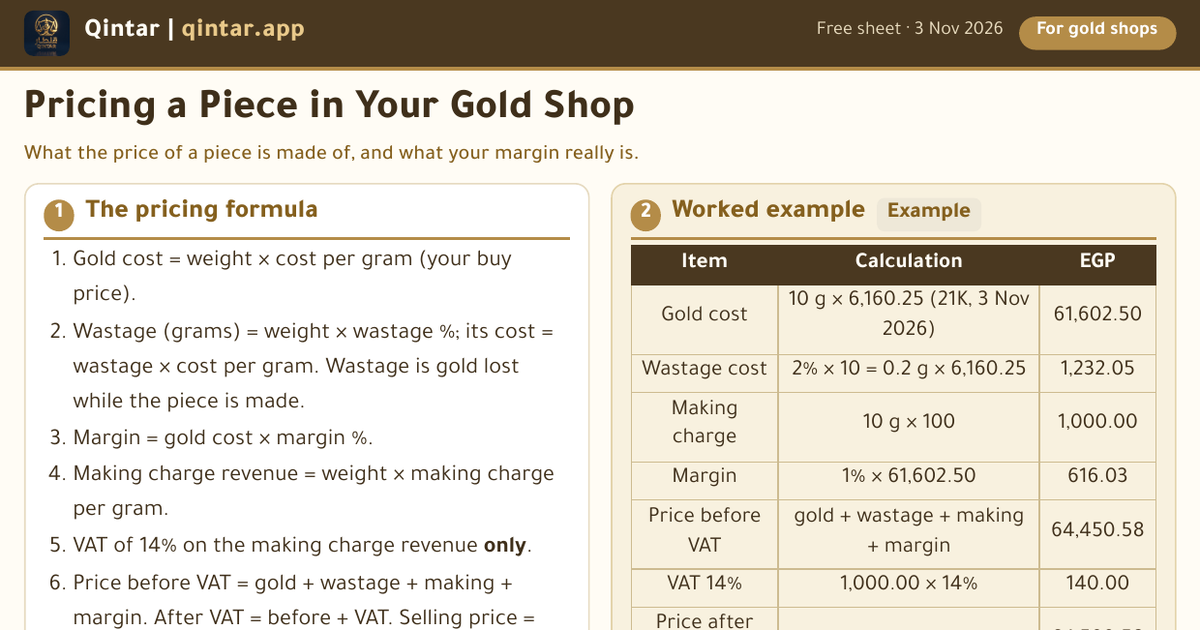
Gold is costed at the buy price (EGP 6,160.25 for 21K and EGP 5,259.00 for 18K, 3 Nov 2026). The chain has 2% wastage and a making charge of EGP 100 per gram; the ring 3% and EGP 150. The margin is 1% on the gold and the price is rounded to the nearest EGP 10. All of these are example figures, not recommendations.
| Item | 21K chain | 18K ring |
|---|---|---|
| Weight (g) | 10 | 4 |
| Gold price per gram (cost) | 6,160.25 | 5,259.00 |
| Gold cost | 61,602.50 | 21,036.00 |
| Wastage (g) | 0.2 | 0.12 |
| Wastage cost | 1,232.05 | 631.08 |
| Making charge revenue | 1,000.00 | 600.00 |
| Gold margin (1% of gold cost) | 616.03 | 210.36 |
| Price before VAT | 64,450.58 | 22,477.44 |
| 14% VAT on the making charge | 140.00 | 84.00 |
| Price after VAT | 64,590.58 | 22,561.44 |
| Selling price, rounded | 64,590.00 | 22,560.00 |
| Price per gram | 6,459.06 | 5,640.36 |
| Margin in EGP | 1,615.45 | 808.92 |
VAT is charged on the making charge only (EGP 1,000.00 on the chain and EGP 600.00 on the ring), not on the gold. The margin in EGP is the selling price less the gold cost, the wastage cost and the VAT: EGP 1,615.45 on the chain, before the shop's own expenses.
Explained: What the price of a gold piece is made of
A price on a gold shop counter in Egypt is not one number but six, added in a fixed order. Writing them down for every piece keeps your prices consistent and lets you explain any of them to a customer.
The first is the gold: the weight of the piece times the price per gram at which you buy that karat today. In the example, a 10 g 21K chain at EGP 6,160.25 per gram holds EGP 61,602.50 of gold. The second is wastage, the gold lost while the piece is made. It is a percent you know from your own workshop; the sheet does not suggest one. At the example's 2%, the chain loses 0.2 g, worth EGP 1,232.05.
The third is the making charge, quoted per gram as is usual in Egypt: EGP 100 per gram in the example, so EGP 1,000.00 for the chain. The fourth is your margin, here a percent added to the gold cost, which gives EGP 616.03 at 1%.
The fifth is VAT, and here the rule matters: VAT of 14% is charged on the making charge only, not on the gold. On the chain that is EGP 140.00, not 14% of the whole price. The vat cell holds the rate, so you can change it if it changes. The sixth step is rounding. A price like EGP 64,590.58 is awkward on a tag, so the sheet rounds to the step you choose with ROUND(price ÷ step) × step, which gives EGP 64,590.00 here.
Because every part has its own column, you can see at once what drives a price. A heavier piece is mostly gold; a light piece with fine work is mostly making charge. And when a customer asks why a price changed since yesterday, the gold column shows how much of the change came from the gold price.
- Wastage and making charge: how to work them out
- 14% VAT on the making charge only: a worked example
Questions people ask
Is VAT charged on the gold in the price?
No. In this sheet VAT of 14% is charged on the making charge only, and the rate sits in a cell you can change. Check tax matters with your accountant.
What wastage and margin should I use?
The sheet does not suggest any. Wastage depends on your workshop and the piece, and the margin is your decision. The figures in the file are marked as examples.
How does the rounding work?
The selling price is ROUND(price ÷ step) × step, so with a step of 10 EGP a price goes to the nearest 10 EGP. You can pick 1, 5, 10 or 50.
Related calculators and guides
Prices and calculations are for information only. They are not financial advice, an offer to buy or sell, or a religious ruling. Check tax matters with your accountant.
Live prices are in the app. The Qintar app shows gold and silver buy and sell prices in Egypt, your holdings at today's price and a zakat calculator. It is free, with no ads.
More free sheets
- Gold Shop Daily Ledger: Sales, Purchases, Gold FlowHow many grams came in and went out today, and where your balance stands.
- Old-for-New Gold Exchange Quote for CustomersHand the customer a clear, itemized exchange calculation.
- Fair Price Sheet for Any Gold PieceDid you pay a normal price for that bar, coin or bracelet?